





































What information is included in the AEAS Report?
The AEAS Report provides families, schools and education agents with independent and objective information about a student’s English language proficiency, Mathematical Reasoning and General Ability.
The report helps you understand the results, identify suitable schools and plan any English preparation needed before school entry. You can discuss the recommendations with your chosen school or education agent alongside recent school reports and the school’s entry requirements.

English language proficiency
An overall score out of 100, together with a score and normalised score (stanine) for each English language subtest.
Mathematical Reasoning and General Ability
Raw and normalised scores that provide further information about the student’s abilities and should be considered alongside their school reports.
Preparation and placement recommendations
Recommendations for the minimum number of weeks of intensive English preparation, the student’s school entry level and the year and timing of commencement.
There is no pass or fail score for the AEAS Test.
Each school determines its own entry requirements and makes the final decision about admission.
How many weeks of an intensive English language course will a student require?
The recommended minimum period of intensive English preparation is determined by the student’s AEAS English score and intended year level of entry. The individual AEAS Report specifies the minimum number of weeks recommended for that student.
These recommendations draw on more than 40 years of AEAS results and research into how school-age students acquire English. Preparation needs to develop the academic English used to understand lessons, read subject texts and complete written work, as well as the language used in everyday conversation.
The following recommendations apply to reports issued from 1 December 2026.
| AEAS score | CEFR | English level | Years 10–12Upper secondary Weeks |
Years 7–9Lower secondary Weeks |
Years 4–6Primary Weeks |
|---|---|---|---|---|---|
| 0–25 | Pre-A1 | Beginner | 40–48 | 32–40 | 16–24 |
| 26–35 | A1 | Elementary | 32–40 | 24–32 | 12–16 |
| 36–45 | A2 | Pre-Intermediate | 26–32 | 18–24 | 10–12 |
| 46–60 | B1 | Intermediate | 20–26 | 12–18 | 8–10 |
| 61–65 | B2 | Upper Intermediate | 16–18 | 12 | 6–8 |
| 66–70 | B2 | Upper Intermediate | 12–16 | 10 | 0 |
| 71–75 | B2+ | Pre-Advanced | 10–12 | 8 | 0 |
| 76–80 | B2+ | Pre-Advanced | 8–10 | 0 | 0 |
| 81+ | C1 | Advanced | 0 | 0 | 0 |
AEAS score: 0–25
- CEFR
- Pre-A1
- English level
- Beginner
- Years 10–12 · Upper secondary
- 40–48
Weeks - Years 7–9 · Lower secondary
- 32–40
Weeks - Years 4–6 · Primary
- 16–24
Weeks
AEAS score: 26–35
- CEFR
- A1
- English level
- Elementary
- Years 10–12 · Upper secondary
- 32–40
Weeks - Years 7–9 · Lower secondary
- 24–32
Weeks - Years 4–6 · Primary
- 12–16
Weeks
AEAS score: 36–45
- CEFR
- A2
- English level
- Pre-Intermediate
- Years 10–12 · Upper secondary
- 26–32
Weeks - Years 7–9 · Lower secondary
- 18–24
Weeks - Years 4–6 · Primary
- 10–12
Weeks
AEAS score: 46–60
- CEFR
- B1
- English level
- Intermediate
- Years 10–12 · Upper secondary
- 20–26
Weeks - Years 7–9 · Lower secondary
- 12–18
Weeks - Years 4–6 · Primary
- 8–10
Weeks
AEAS score: 61–65
- CEFR
- B2
- English level
- Upper Intermediate
- Years 10–12 · Upper secondary
- 16–18
Weeks - Years 7–9 · Lower secondary
- 12
Weeks - Years 4–6 · Primary
- 6–8
Weeks
AEAS score: 66–70
- CEFR
- B2
- English level
- Upper Intermediate
- Years 10–12 · Upper secondary
- 12–16
Weeks - Years 7–9 · Lower secondary
- 10
Weeks - Years 4–6 · Primary
- 0
Weeks
AEAS score: 71–75
- CEFR
- B2+
- English level
- Pre-Advanced
- Years 10–12 · Upper secondary
- 10–12
Weeks - Years 7–9 · Lower secondary
- 8
Weeks - Years 4–6 · Primary
- 0
Weeks
AEAS score: 76–80
- CEFR
- B2+
- English level
- Pre-Advanced
- Years 10–12 · Upper secondary
- 8–10
Weeks - Years 7–9 · Lower secondary
- 0
Weeks - Years 4–6 · Primary
- 0
Weeks
AEAS score: 81+
- CEFR
- C1
- English level
- Advanced
- Years 10–12 · Upper secondary
- 0
Weeks - Years 7–9 · Lower secondary
- 0
Weeks - Years 4–6 · Primary
- 0
Weeks
All preparation periods are expressed in weeks. A value of 0 means no intensive English preparation is recommended under the matrix.
A full-time, school-equivalent program. Recommendations assume that students attend this type of program in the destination country for at least the minimum number of weeks specified. Preparation undertaken elsewhere may take longer.
Confirming readiness before school commencement
Students should re-test after completing their intensive English program and before commencing mainstream school. Where 30 or more weeks have been recommended, students should re-test at least four to six weeks before their intended commencement date to confirm sufficient progress or allow time to adjust and increase their English preparation.
The enrolling school makes the final decision on entry.
Understanding stanine scores
Stanines report results on a normalised nine-point scale, with a mean of 5 and a standard deviation of 2. They provide a way to describe a student’s performance in broad terms relative to the comparison population.
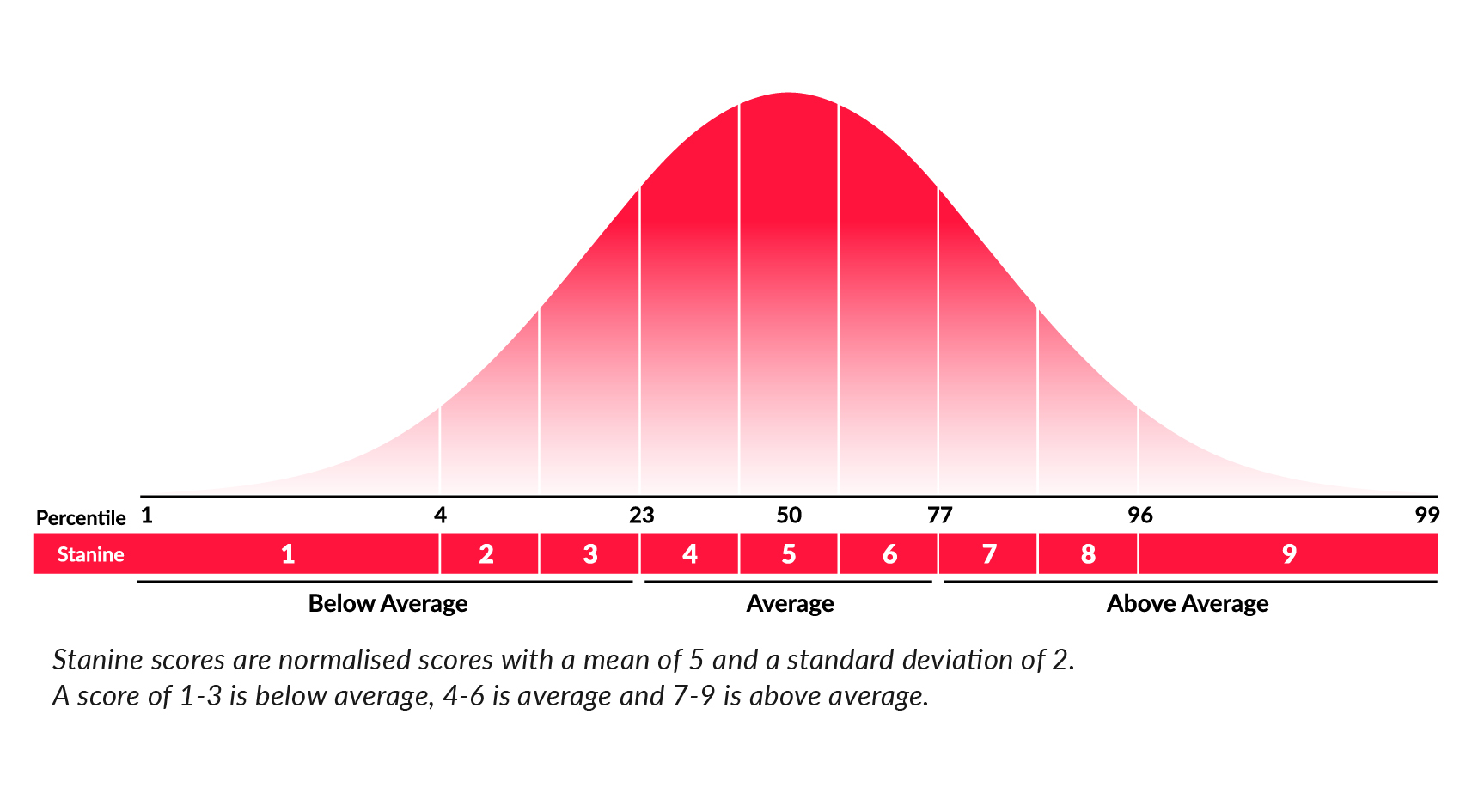
What do General Ability and Mathematical Reasoning results tell you?
The Non-verbal General Ability test contains no English content and does not require learned subject knowledge. It assesses how a student thinks through unfamiliar problems, providing information about their abilities independently of their English proficiency.
The Mathematical Reasoning test assesses problem-solving and reasoning rather than recall of a particular school curriculum. Its questions are written in English, so a student who is still developing their English may find it harder to demonstrate their mathematical ability.
Together with recent school reports, these results help you understand the student’s strengths and where additional time, teaching or classroom support may be helpful. They provide a basis for discussing suitable year levels and subjects with your chosen school.
Understanding the two stanine comparison populations
A stanine indicates how a student’s performance compares with a defined group of students, known as the comparison population. AEAS uses two different comparison populations, depending on the area being assessed:
- English language proficiency
- Results are compared with those of international students for whom English is not their first language. The stanine therefore describes performance relative to this group of English language learners.
- Mathematical Reasoning and General Ability
- Results are compared with those of students regardless of their language background. This population includes both students whose first language is English and students whose first language is another language.
The same stanine in English and in Mathematical Reasoning or General Ability therefore describes a similar position within different comparison populations. General Ability and Mathematical Reasoning results should also be interpreted together with the student’s school reports.
Year level and timing of entry
The AEAS Report recommends an appropriate year level for school entry and the year and timing of commencement. This helps families plan for any English preparation needed before mainstream classes begin.
When planning school entry, discuss the report’s recommendations with your chosen school, taking into account the student’s age, completed schooling, academic history and intended start date. The school will confirm the year level and commencement date as part of its admissions process.
The year levels used in the English preparation table refer to the Australian education system. The conversion table below provides a reference for other school systems.
Country, age and year level conversions
| Age | Australia | Canada | China | New Zealand | Thailand | UK | USA | Vietnam |
|---|---|---|---|---|---|---|---|---|
| Academic year | Jan–Dec | Sep–Jun | Sep–Jul | Jan–Dec | May–Feb | Sep–Jun | Sep–Jun | Sep–May |
| 3 | Pre-school | Pre-school | Pre-school | Pre-school | Pre-Kindergarten | Reception | Pre-school | Pre-school |
| 4 | Pre-school | Pre-school | Pre-school | Kindergarten | Kindergarten 1 | Reception | Pre-school | Pre-school |
| 5 | Prep | Kindergarten | Pre-school | Year 1 | Kindergarten 2 | Year 1 | Kindergarten | Pre-school |
| 6 | Year 1 | Grade 1 | Year 1 | Year 2 | Prathom 1 | Year 2 | Grade 1 | Grade 1 |
| 7 | Year 2 | Grade 2 | Year 2 | Year 3 | Prathom 2 | Year 3 | Grade 2 | Grade 2 |
| 8 | Year 3 | Grade 3 | Year 3 | Year 4 | Prathom 3 | Year 4 | Grade 3 | Grade 3 |
| 9 | Year 4 | Grade 4 | Year 4 | Year 5 | Prathom 4 | Year 5 | Grade 4 | Grade 4 |
| 10 | Year 5 | Grade 5 | Year 5 | Year 6 | Prathom 5 | Year 6 | Grade 5 | Grade 5 |
| 11 | Year 6 | Grade 6 | Year 6 | Year 7 | Prathom 6 | Year 7 | Grade 6 | Grade 6 |
| 12 | Year 7 | Grade 7 | Year 7 | Year 8 | Matayom 1 | Year 8 | Grade 7 | Grade 7 |
| 13 | Year 8 | Grade 8 | Year 8 | Year 9 | Matayom 2 | Year 9 | Grade 8 | Grade 8 |
| 14 | Year 9 | Grade 9 | Year 9 | Year 10 | Matayom 3 | Year 10 (GCSE) | Grade 9 | Grade 9 |
| 15 | Year 10 | Grade 10 | Year 10 | Year 11 | Matayom 4 | Year 11 (GCSE) | Grade 10 (Sophomores) | Grade 10 |
| 16 | Year 11 | Grade 11 | Year 11 | Year 12 | Matayom 5 | Year 12 (A Levels) | Grade 11 (Juniors) | Grade 11 |
| 17 | Year 12 | Grade 12 | Year 12 | Year 13 | Matayom 6 | Year 13 (A Levels) | Grade 12 (Seniors) | Grade 12 |
| 18 | University / College | |||||||
Receiving the AEAS Report
Each three-page report is individually prepared at AEAS head office. Alongside test results and recommendations, it includes information about the student’s preferred course of study, long-term goals, interests, activities and any health considerations.
Reports are available within 10 business days of testing, or sooner. Priority reports can be requested for an additional fee.
The completed report is forwarded to:
- The student and their family
- The school or schools to which the student is applying
- The student’s nominated education agent, where applicable.
For confirmation of an enrolment offer or school commencement date, contact the school to which you have applied.
Verifying a report
You can check the authenticity of an AEAS Report using the QR code on page three or the AEAS Results Verification Portal.
How recent should results be?
AEAS Reports do not have a formal validity period. However, students’ skills develop over time. Check with your chosen school whether your existing report is recent enough for your application and intended start date, or whether you need to take another AEAS Test.
How do AEAS scores align with the CEFR?
The Common European Framework of Reference for Languages (CEFR) describes language proficiency across a series of levels. The updated AEAS recommendations align score bands with CEFR levels from Pre-A1 to C1, as shown in the English preparation table.
This alignment forms part of a significant internal review drawing on AEAS results, research into how school-age students acquire English, the Global Scale of English for Young Learners and consultation with experienced educators.
The student’s intended year level remains central to the recommended preparation period, reflecting the academic language demands of their school studies.